Classroom management strategies in building student character at a superior elementary school based on the wetland ecoregion in North Banjarmasin District
DOI:
https://doi.org/10.58362/hafecspost.v4i2.147Kata Kunci:
character development, classroom management, high-performing school, teacher training, wetland areaAbstrak
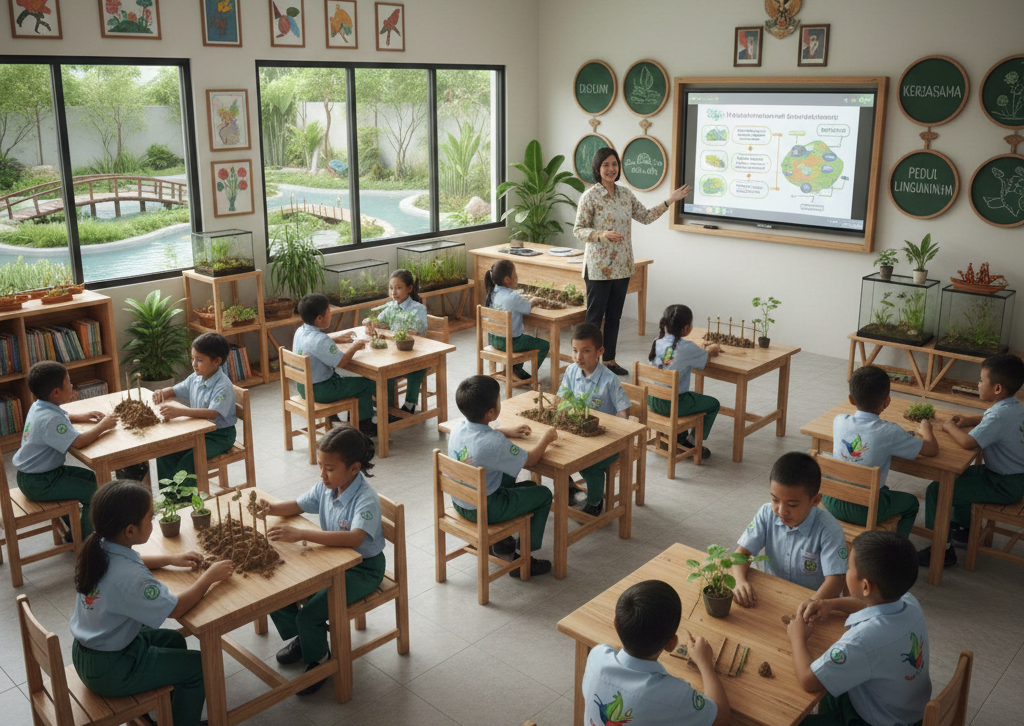
Ineffective classroom management can hinder efforts to develop students’ character, particularly in high-performing public elementary schools (SDN Unggul) located in wetland areas such as North Banjarmasin District. The unique environmental characteristics of these regions require more adaptive and context-based classroom management strategies. This community service activity aimed to enhance teachers’ capacity through training on classroom management strategies that support character development. The methods employed included participatory training through material delivery, group discussions, case studies, and hands-on classroom practice. The results showed a significant improvement in teachers’ competencies. The average score for classroom management understanding increased from 65.2 to 85.6 (+20.4), the ability to implement character-building strategies rose from 58.4 to 82.8 (+24.4), and proactive attitudes toward innovation improved from 60.1 to 87.2 (+27.1). The impact on students was also clearly measurable. Character observations indicated improvements in discipline from 68% to 85% (+17), responsibility from 62% to 83% (+21), cooperation from 59% to 80% (+21), and independence from 55% to 77% (+22). These findings affirm that contextually designed classroom management strategy training can make a tangible and measurable contribution to improving teacher competence and student character in high-performing elementary schools located within wetland ecoregions.
Abstrak. Permasalahan manajemen kelas yang kurang efektif dapat menghambat upaya pembentukan karakter siswa, terutama di Sekolah Dasar Negeri (SDN) Unggul yang berada di kawasan lahan basah seperti Kecamatan Banjarmasin Utara. Karakteristik lingkungan yang khas menuntut adanya strategi pengelolaan kelas yang lebih adaptif dan kontekstual. Kegiatan pengabdian ini bertujuan untuk meningkatkan kapasitas guru melalui pelatihan strategi manajemen kelas yang mendukung penguatan karakter siswa. Metode yang digunakan meliputi pelatihan partisipatif melalui penyampaian materi, diskusi kelompok, studi kasus, dan praktik langsung di kelas. Hasil kegiatan menunjukkan peningkatan kompetensi guru yang signifikan. Rata-rata pemahaman manajemen kelas meningkat dari 65,2 menjadi 85,6 (+20,4), kemampuan penerapan strategi karakter naik dari 58,4 menjadi 82,8 (+24,4), dan sikap proaktif terhadap inovasi meningkat dari 60,1 menjadi 87,2 (+27,1). Dampaknya terhadap siswa juga terukur secara jelas. Observasi karakter menunjukkan peningkatan pada indikator disiplin dari 68% menjadi 85% (+17), tanggung jawab dari 62% menjadi 83% (+21), kerja sama dari 59% menjadi 80% (+21), dan kemandirian dari 55% menjadi 77% (+22). Temuan ini menegaskan bahwa pelatihan strategi manajemen kelas yang dirancang secara kontekstual dapat memberikan kontribusi nyata dan terukur dalam meningkatkan kompetensi guru serta karakter siswa di sekolah dasar unggul yang berada di wilayah ekoregion lahan basah.
Referensi
Annisa, M., Asrani, A., Serlinda, S., Kasih, S., & Maulana, S. (2022). Analysis of students' knowledge about natural disaster mitigation in wetland areas. Journal of Innovation in Educational and Cultural Research, 3(1), 12-19. https://doi.org/10.46843/jiecr.v3i1.48
Anriyani, L., Yandri, H., & Kusayang, T. (2024). Analisis dinamika self efficacy dan motivasi kerja terhadap kinerja guru Pendidikan Anak Usia Dini. As-Sibyan: Jurnal Pendidikan Anak Usia Dini, 9(1), 55-72. https://doi.org/10.32678/assibyan.v9i1.9862
Arni, Y., Wahyuningsih, S., Lia, L., & Fitri, E. A. (2025). Penguatan kesiapsiagaan bencana melalui pendidikan mitigasi di SD Sungai Pedada, Tulung Selapan. KOMUNITA: Jurnal Pengabdian dan Pemberdayaan Masyarakat, 4(2), 242-252. https://doi.org/10.60004/komunita.v4i2.182
Darling-Hammond, L., Hyler, M. E., & Gardner, M. (2017). Effective Teacher Professional Development. Palo Alto, CA: Learning Policy Institute. https://doi.org/10.54300/122.311
Emmer, E. T., & Evertson, C. M. (2016). Classroom Management for Middle and High School Teachers (10th ed.). Pearson.
Fauziah, S., Amaliah, S. N., Munawaroh, S., & Roichanah, S. (2025). Peningkatan kompetensi pedagogik dan profesional guru melalui pelatihan berbasis lesson study di Sekolah Dasar. Journal of Innovation Research and Knowledge, 4(12), 9127-9136. https://doi.org/10.53625/jirk.v4i12.10187
Joyce, B., & Showers, B. (2002). Student Achievement through Staff Development (3rd ed.). ASCD. https://www.unrwa.org/sites/default/files/joyce_and_showers_coaching_as_cpd.pdf
Kemendikbudristek. (2022). Kurikulum Merdeka dan Implementasi Profil Pelajar Pancasila. Jakarta: Kementerian Pendidikan, Kebudayaan, Riset, dan Teknologi.
Knowles, M. S., Holton, E. F., & Swanson, R. A. (2015). The Adult Learner: The Definitive Classic in Adult Education and Human Resource Development (8th ed.). Routledge. https://www.aallnet.org/ripssis/resources-publications/legal-research-text-reviews/
Lami'ah, S., Suciptaningsih, O. A., Anggraini, A. E., Suyitno, I., & Kusumaningrum, S. R. (2025). Internalisasi nilai kearifan lokal budaya Sasak dalam pembelajaran Sekolah Dasar untuk penguatan karakter akademik siswa. Didaktika: Jurnal Kependidikan, 14(4), 6061-6074. https://doi.org/10.58230/27454312.3173
Lickona, T. (1991). Educating for Character: How Our Schools Can Teach Respect and Responsibility. Bantam Books. https://eric.ed.gov/?id=ED337451
Luthfi, A. K., Wahyuni, S., & Rahmadania, L. (2025). Penguatan literasi anak pesisir melalui pendekatan edukasi kontekstual berbasis lingkungan. Daya Karya: Jurnal Pemberdayaan Masyarakat, 1(1), 54-64. https://indosainstech.id/journal/dayakarya/article/view/6
Marcinkowski, T. (2025). Education about, in, and for wetlands: Practices, premises, possibilities, and challenges. Frontiers in Water, 7, 1604496. https://doi.org/10.3389/frwa.2025.1604496
Montessori, M. (1967). The Absorbent Mind. Holt, Rinehart and Winston.
Mulianti, W. O., & Sulisworo, D. (2023). Character education management of elementary school students. International Journal of Learning Reformation in Elementary Education, 2(1), 1-13. https://doi.org/10.56741/ijlree.v2i01.140
Panggabean, R. R., Astari, Y. P., & Sari, I. P. (2022). Implementation of school-based management in improving the character quality of elementary school students. Indonesian Values and Character Education Journal, 5(1), 1-8. https://doi.org/10.23887/ivcej.v5i1.42324
Rahman, H., Thalib, S. B., & Mahmud, A. (2017). Integrated character education in social sciences with contextual teaching and learning approach. The New Educational Review, 48, 53-64. https://doi.org/10.15804/tner.2017.48.2.04
Rao, N. M., Rehman, C. A., Bajwa, S. U., & Nasir, N. (2024). Role of teachers in the character development of students: Findings from a systematic review. Academy of Education and Social Sciences Review, 4(4), 575-594. https://doi.org/10.48112/aessr.v4i4.935
Rochwulaningsih, Y., Masruroh, N. N., Sholihah, F., Widodo, S. K., & Budiyanto, S. (2020). Managing socio-economic problems of the wetland environment in South Kalimantan. In E3S Web of Conferences (Vol. 202, p. 03025). EDP Sciences. https://doi.org/10.1051/e3sconf/202020203025
Santrock, J. W. (2011). Educational Psychology (5th ed.). McGraw-Hill.
Salama, M. S., Utaminingsih, E. S., Ramadhani, M. H., & Intania, B. Y. (2025). Classroom management and student behavior in primary schools: A systematic review of strategies and practices. Jurnal Ilmiah Profesi Pendidikan, 10(2), 1668-1678. https://doi.org/10.29303/jipp.v10i2.3383
Shank, G. D. (2005). Qualitative Research: A Personal Skills Approach. Pearson.
Simonsen, B., Fairbanks, S., Briesch, A., Myers, D., & Sugai, G. (2008). Evidence-based practices in classroom management: Considerations for research to practice. Education and treatment of children, 31(3), 351-380. https://doi.org/10.1353/etc.0.0007
Supadi, S., Soraya, E., Muhammad, H., & Halim, N. (2021). Making sense the teacher evaluation with the value of local culture (the voice of school principals in Indonesia). International Journal of Educational Management, 35(6), 1124-1135. https://doi.org/10.1108/IJEM-08-2020-0408
Tuuk, G. K., & Ratulangi, C. R. (2025). Pendidikan karakter dalam pembelajaran matematika: Tantangan dan solusi di sekolah wilayah 3T: Studi kasus SMP Advent Wamena. Jurnal Ilmiah Matematika (JIMAT), 6(1), 155-164. https://doi.org/10.63976/jimat.v6i1.800
Vaughn, M. (2015). Adaptive teaching: Reflective practice of two elementary teachers’ visions and adaptations during literacy instruction. Reflective Practice, 16(1), 43-60. https://doi.org/10.1080/14623943.2014.944143
Vygotsky, L. S. (1978). Mind in Society: The Development of Higher Psychological Processes. Harvard University Press.
Unduhan
Diterbitkan
Terbitan
Bagian
Lisensi
Hak Cipta (c) 2025 Suhaimi Suhaimi, Noorahim W., Ni'mah Ni'mah

Artikel ini berlisensiCreative Commons Attribution-NonCommercial-ShareAlike 4.0 International License.

This work is licensed under a Creative Commons Attribution-NonCommercial-ShareAlike 4.0 International License.