Opportunities for integrating gamification and emerging technologies with direct observation in biology education: A bibliometric analysis
DOI:
https://doi.org/10.58362/hafecspost.v5i1.164Keywords:
gamification, direct observation, emerging technology, biology education, bibliometricsAbstract
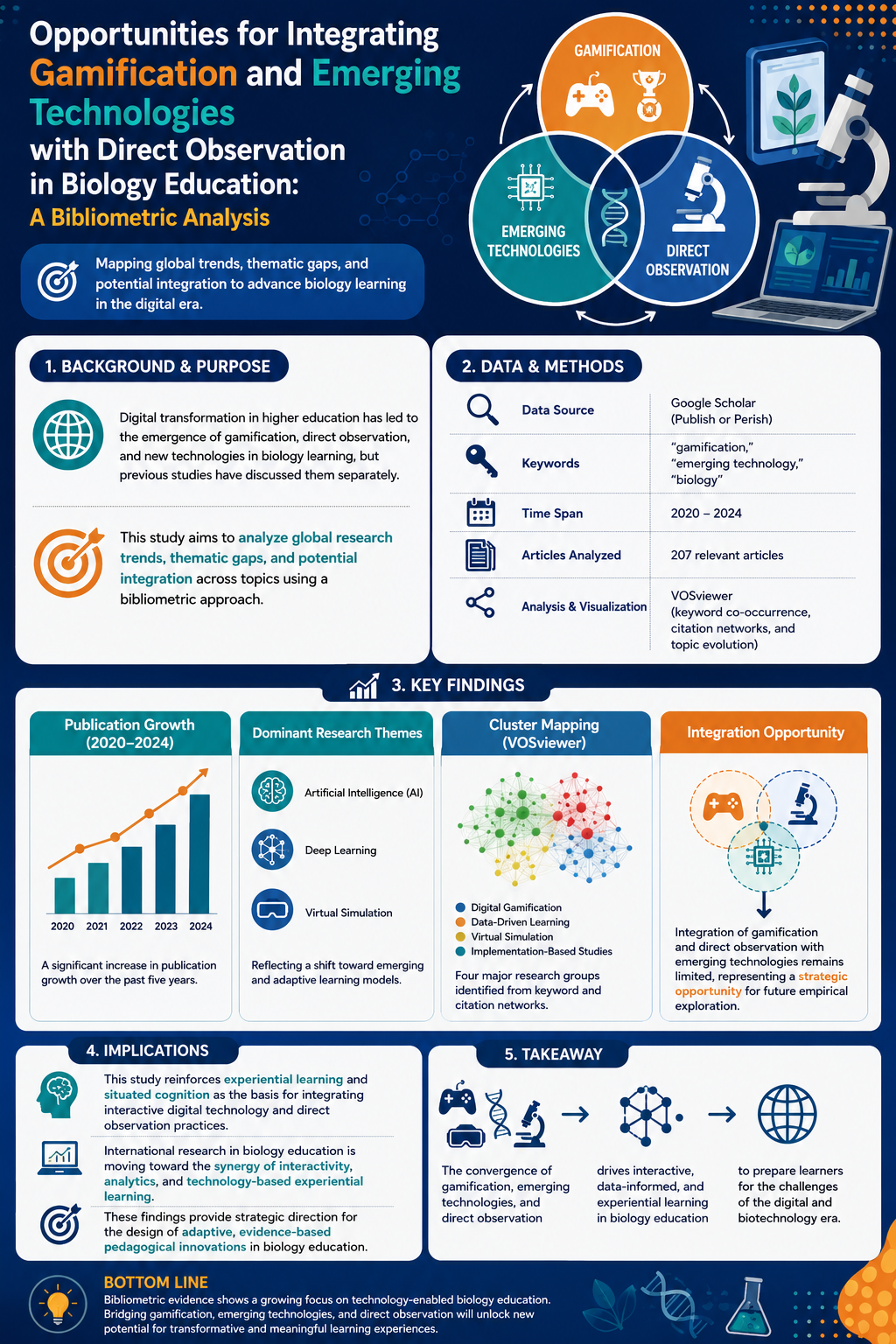
Digital transformation in higher education has led to the emergence of gamification, direct observation, and new technologies in biology learning, but previous studies have discussed them separately. To date, there has been no bibliometric study that systematically maps the integration of these three approaches. This study aims to analyze global research trends, thematic gaps, and potential integration across topics using a bibliometric approach. Data were retrieved from Google Scholar through the Publish or Perish application using the keywords “gamification,” “emerging technology,” and “biology,” covering publications from 2020 to 2024. A total of 207 relevant articles were analyzed and visualized using VOSviewer to map bibliometric relationships based on keyword co-occurrence, citation networks, and topic evolution. The results indicate a significant increase in publication growth over the past five years, with dominant themes such as artificial intelligence, deep learning, and virtual simulation, reflecting a shift toward emerging and adaptive learning models. Cluster mapping identified four major research groups: digital gamification, data-driven learning, virtual simulation, and implementation-based studies. These findings confirm that international research in biology education is moving toward the synergy of interactivity, analytics, and technology-based experiential learning. Nevertheless, the integration of gamification and direct observation with emerging technologies remains limited, representing a strategic opportunity for future empirical exploration. This study reinforces experiential learning and situated cognition as the basis for integrating interactive digital technology and direct observation practices. These findings also provide strategic direction for the design of adaptive, evidence-based pedagogical innovations in biology education.
Abstrak. Transformasi digital dalam pendidikan tinggi mendorong munculnya gamifikasi, pengamatan langsung, dan teknologi baru dalam pembelajaran biologi, namun kajian sebelumnya masih membahasnya secara terpisah. Hingga kini, belum ada studi bibliometric yang memetakan secara sistematis integrasi ketiga pendekatan tersebut. Penelitian ini bertujuan untuk menganalisis tren penelitian global, kesenjangan tematik, serta potensi integrasi antartopik melalui pendekatan bibliometrik. Data diperoleh dari basis Google Scholar menggunakan aplikasi Publish or Perish dengan kata kunci “gamification”, “emerging technology”, dan “biology”, mencakup publikasi tahun 2020–2024. Sebanyak 207 artikel yang relevan dianalisis dan divisualisasikan menggunakan VOSviewer untuk menggambarkan keterkaitan bibliometrik berdasarkan jejaring kata kunci, sitasi, dan evolusi tren riset. Hasil analisis menunjukkan peningkatan publikasi yang signifikan dalam lima tahun terakhir, dengan dominasi tema artificial intelligence, deep learning, dan virtual simulation yang mencerminkan pergeseran riset menuju integrasi teknologi imersif dan pembelajaran adaptif. Pemetaan klaster mengidentifikasi empat kelompok utama, yaitu gamifikasi digital, pembelajaran berbasis data, simulasi virtual, dan penelitian implementatif. Temuan ini menegaskan bahwa riset internasional dalam pembelajaran biologi bergerak ke arah sinergi antara interaktivitas, analitik, dan pengalaman belajar berbasis teknologi. Kajian ini juga mengungkap bahwa integrasi gamifikasi dan pengamatan langsung dengan teknologi baru masih terbatas, sehingga menjadi peluang strategis untuk penelitian lanjutan. Penelitian ini memperkuat dasar experiential learning dan situated cognition sebagai landasan integrasi antara digital interaktif dan praktik observasi langusng. Temuan ini juga memberikan arah strategis bagi perancangan inovasi pedagogis yang adaptif dan berbasis bukti dalam pembelajaran biologi.
References
Abbasi, G. A., Tiew, L. Y., Tang, J., Goh, Y. N., & Thurasamy, R. (2021). The adoption of cryptocurrency as a disruptive force: Deep learning-based dual stage structural equation modelling and artificial neural network analysis. Plos one, 16(3), e0247582. https://doi.org/10.1371/journal.pone.0247582
Aguiar-Castillo, L., Hernández-López, L., De Saá-Pérez, P., & Perez-Jimenez, R. (2020). Gamification as a motivation strategy for higher education students in tourism face-to-face learning. Journal of Hospitality, Leisure, Sport & Tourism Education, 27, 100267. https://doi.org/10.1016/j.jhlste.2020.100267
Al Balushi, J. S. G., Al Jabri, M. I. A., Palarimath, S., Maran, P., Thenmozhi, K., & Balakumar, C. (2024, June). Incorporating artificial intelligence powered immersive realities to improve learning using virtual reality (VR) and augmented reality (AR) technology. In 2024 3rd International Conference on Applied Artificial Intelligence and Computing (ICAAIC) (pp. 760-765). IEEE. https://doi.org/10.1109/ICAAIC60222.2024.10575046
Bereiter, C. (2021). Situated cognition and how to overcome it. In Situated cognition (pp. 281-300). Routledge.
Brown, M., McCormack, M., Reeves, J., Brook, D. C., Grajek, S., Alexander, B., ... & Weber, N. (2020). 2020 educause horizon report teaching and learning edition (pp. 2-58). Educause. https://www.learntechlib.org/p/215670/
Chen, X., Zou, D., Xie, H., & Wang, F. L. (2021). Past, present, and future of smart learning: A topic-based bibliometric analysis. International Journal of Educational Technology in Higher Education, 18(1), 2. https://doi.org/10.1186/s41239-020-00239-6
Chengoden, R., Victor, N., Huynh-The, T., Yenduri, G., Jhaveri, R. H., Alazab, M., ... & Gadekallu, T. R. (2023). Metaverse for healthcare: a survey on potential applications, challenges and future directions. IEEE access, 11, 12765-12795. https://doi.org/10.1109/ACCESS.2023.3241628
Contractor, J. B., Rathod, S., & Singh, P. (2025). Exploring competency-based anatomy education through direct observation with checklist as teaching-learning and assessment method: Lessons learnt through student feedback. Journal of Medical Education and Curricular Development, 12, 23821205251321807. https://doi.org/10.1177/23821205251321807
Donthu, N., Kumar, S., Mukherjee, D., Pandey, N., & Lim, W. M. (2021). How to conduct a bibliometric analysis: An overview and guidelines. Journal of business research, 133, 285-296. https://doi.org/10.1016/j.jbusres.2021.04.070
Fahmi, F., Fajeriadi, H., & Irhasyuarna, Y. (2021). Feasibility of the prototype of teaching materials on the topic of classification of living things based on the advantage of local wetland. BIO-INOVED: Jurnal Biologi-Inovasi Pendidikan, 3(2), 113-118. https://dx.doi.org/10.20527/bino.v3i2.10322
Fajeriadi, H., & Fitriani, A. (2024). Identifikasi tren penelitian dan peluang inovasi pembelajaran melalui analisis bibliometrik strategi pembelajaran biologi di sekolah menengah. Journal of Bio-Creaducation, 1(1), 8-14. https://doi.org/10.20527/bioco.v1i1.13103
Fajeriadi, H., Azzam, M. N., & Azzahra, F. G. (2025). The effect of local potential-based biology learning resources on students' competencies: An in-depth analysis. Biosfer: Jurnal Pendidikan Biologi, 18(2), 315-326. https://doi.org/10.21009/biosferjpb.54745
Figueiredo, J., & García-Peñalvo, F. J. (2020, April). Increasing student motivation in computer programming with gamification. In 2020 IEEE Global Engineering Education Conference (EDUCON) (pp. 997-1000). IEEE. https://doi.org/10.1109/EDUCON45650.2020.9125283
Gandedkar, N. H., Wong, M. T., & Darendeliler, M. A. (2021, June). Role of virtual reality (VR), augmented reality (AR) and artificial intelligence (AI) in tertiary education and research of orthodontics: An insight. In Seminars in Orthodontics (Vol. 27, No. 2, pp. 69-77). WB Saunders. https://doi.org/10.1053/j.sodo.2021.05.003
Gupta, P., Kulkarni, T., & Toksha, B. (2022). AI-based predictive models for adaptive learning systems. In Artificial Intelligence in Higher Education (pp. 113-136). CRC Press.
Hayati, A., Juanengsih, N., & Fadlilah, D. R. (2021, March). Laboratory activity-based learning to improve generic science skills on the concept of sensory systems. In Journal of Physics: Conference Series (Vol. 1836, No. 1, p. 012077). IOP Publishing. https://doi.org/10.1088/1742-6596/1836/1/012077
Huang, H., Hwang, G. J., & Chang, S. C. (2023). Facilitating decision making in authentic contexts: an SVVR-based experiential flipped learning approach for professional training. Interactive Learning Environments, 31(8), 5219-5235. https://doi.org/10.1080/10494820.2021.2000435
Huang, Y., Li, Y. J., & Cai, Z. (2023). Security and privacy in metaverse: A comprehensive survey. Big Data Mining and Analytics, 6(2), 234-247. https://doi.org/10.26599/BDMA.2022.9020047
Jainab, J., Audia, A. V., Safitri, Y., Yuli, Y., Ramadhan, M. N., Rahmawati, S., ... & Putra, A. P. (2025). Pemanfaatan media teknologi melalui pendekatan kooperatif dalam pembelajaran biologi untuk meningkatkan hasil dan proses belajar siswa sekolah menengah atas. Journal of Bio-Creaducation, 2(1), 23-27. https://doi.org/10.20527/bioco.v2i1.14129
Jing, Y., Wang, C., Chen, Z., Shen, S., & Shadiev, R. (2024). A bibliometric analysis of studies on technology‐supported learning environments: Hot topics and frontier evolution. Journal of Computer Assisted Learning, 40(3), 1185-1200. https://doi.org/10.1111/jcal.12934
Kartika, N. A., Azzam, M. N., Urrahmah, N. S., Nurhidayah, N., & Raihanum, S. (2025). The application of gamification to learning outcomes and motivation of biology students: A literature review. Journal of Biology Creative Education, 2(2), 77-87. https://doi.org/10.20527/bioco.v2i2.16332
Khatibi, M. B., Badeleh, A., & Khodabandelou, R. (2021). A bibliometric analysis on the research trends of gamification in higher education: 2010-2020. The New Educational Review, 65, 17-28. https://doi.org/10.15804/tner.21.65.3.13
Lahoz-Monfort, J. J., & Magrath, M. J. (2021). A comprehensive overview of technologies for species and habitat monitoring and conservation. BioScience, 71(10), 1038-1062. https://doi.org/10.1093/biosci/biab073
Lampropoulos, G., Keramopoulos, E., Diamantaras, K., & Evangelidis, G. (2022). Augmented reality and gamification in education: A systematic literature review of research, applications, and empirical studies. Applied sciences, 12(13), 6809. https://doi.org/10.3390/app12136809
Li, C., & Xing, W. (2021). Natural language generation using deep learning to support MOOC learners. International Journal of Artificial Intelligence in Education, 31(2), 186-214. https://doi.org/10.1007/s40593-020-00235-x
Luarn, P., Chen, C. C., & Chiu, Y. P. (2023). Enhancing intrinsic learning motivation through gamification: A self-determination theory perspective. The International Journal of Information and Learning Technology, 40(5), 413-424. https://doi.org/10.1108/IJILT-07-2022-0145
Mantello, P., Ho, M. T., Nguyen, M. H., & Vuong, Q. H. (2023). Bosses without a heart: Socio-demographic and cross-cultural determinants of attitude toward Emotional AI in the workplace. AI & society, 38(1), 97-119. https://doi.org/10.1007/s00146-021-01290-1
Marougkas, A., Troussas, C., Krouska, A., & Sgouropoulou, C. (2023). Virtual reality in education: A review of learning theories, approaches and methodologies for the last decade. Electronics, 12(13), 2832. https://doi.org/10.3390/electronics12132832
Melumad, S., & Meyer, R. (2020). Full disclosure: How smartphones enhance consumer self-disclosure. Journal of Marketing, 84(3), 28-45. https://doi.org/10.1177/0022242920912732
Nadi-Ravandi, S., & Batooli, Z. (2022). Gamification in education: A scientometric, content and co-occurrence analysis of systematic review and meta-analysis articles. Education and Information Technologies, 27(7), 10207-10238. https://doi.org/10.1007/s10639-022-11048-x
Ouyang, F., Xu, W., & Cukurova, M. (2023). An artificial intelligence-driven learning analytics method to examine the collaborative problem-solving process from the complex adaptive systems perspective. International Journal of Computer-Supported Collaborative Learning, 18(1), 39-66. https://doi.org/10.1007/s11412-023-09387-z
Passarelli, A. M., & Kolb, D. A. (2023). Using experiential learning theory to promote student learning and development in programs of education abroad. In Student learning abroad (pp. 137-161). Routledge.
Raisch, S., & Krakowski, S. (2021). Artificial intelligence and management: The automation–augmentation paradox. Academy of management review, 46(1), 192-210. https://doi.org/10.5465/amr.2018.0072
Raju, R., Bhat, S., Bhat, S., & Singh, A. B. (2021). Effective usage of gamification techniques to boost student engagement. Journal of Engineering Education Transformations, 713-717. https://doi.org/10.16920/jeet/2021/v34i0/157171
Walkerdine, V. (2021). Redefining the subject in situated cognition theory. In Situated cognition (pp. 57-70). Routledge.
Wang, L., & Nie, Z. (2023, April). Research on adaptive learning in K-12 education in the perspective of teachers' artificial intelligence literacy: Development; technology; improvement strategies. In 2023 5th International Conference on Computer Science and Technologies in Education (CSTE) (pp. 1-8). IEEE. https://doi.org/10.1109/CSTE59648.2023.00059
Wang, M., Dede, C., Grotzer, T. A., & Chen, J. (2025). Understanding and managing the complexities in situated learning in immersive virtual environments: M. Wang et al. Educational technology research and development, 1-24. https://doi.org/10.1007/s11423-025-10519-5
Wang, Y., Huang, X., Mo, Y., Huang, J., Feng, T., Huang, W., & Nie, X. (2024, June). Immersive interactive game design for cultural relics and monuments based on situated cognition theory. In International Conference on Human-Computer Interaction (pp. 180-198). Cham: Springer Nature Switzerland. https://doi.org/10.1007/978-3-031-60692-2_13
Wu, X. Y. (2024). Exploring the effects of digital technology on deep learning: A meta-analysis. Education and Information Technologies, 29(1), 425-458. https://doi.org/10.1007/s10639-023-12307-1
Zhao, D., Li, H., Xu, A., & Song, T. (2022). Psychological mobilization of innovative teaching methods for students' basic educational curriculum reform under deep learning. Frontiers in Psychology, 13, 843493. https://doi.org/10.3389/fpsyg.2022.843493
Downloads
Published
Issue
Section
License
Copyright (c) 2026 Hery Fajeriadi, Aminuddin Prahatama Putra, Bunda Halang, Gt. Muhammad Irhamna Husin, Nurul Aulia, Muhammad Naufal Azzam, Muhammad Abdi Gusti, Hanisa Hanisa

This work is licensed under a Creative Commons Attribution-NonCommercial-ShareAlike 4.0 International License.

This work is licensed under a Creative Commons Attribution-NonCommercial-ShareAlike 4.0 International License.