The relationship between creative thinking skills, opportunity identification skills, and problem-solving abilities among biology education students
DOI:
https://doi.org/10.58362/hafecspost.v5i1.181Keywords:
correlation, creative thinking, opportunity identification skills, problem-solving ability, biology education studentsAbstract
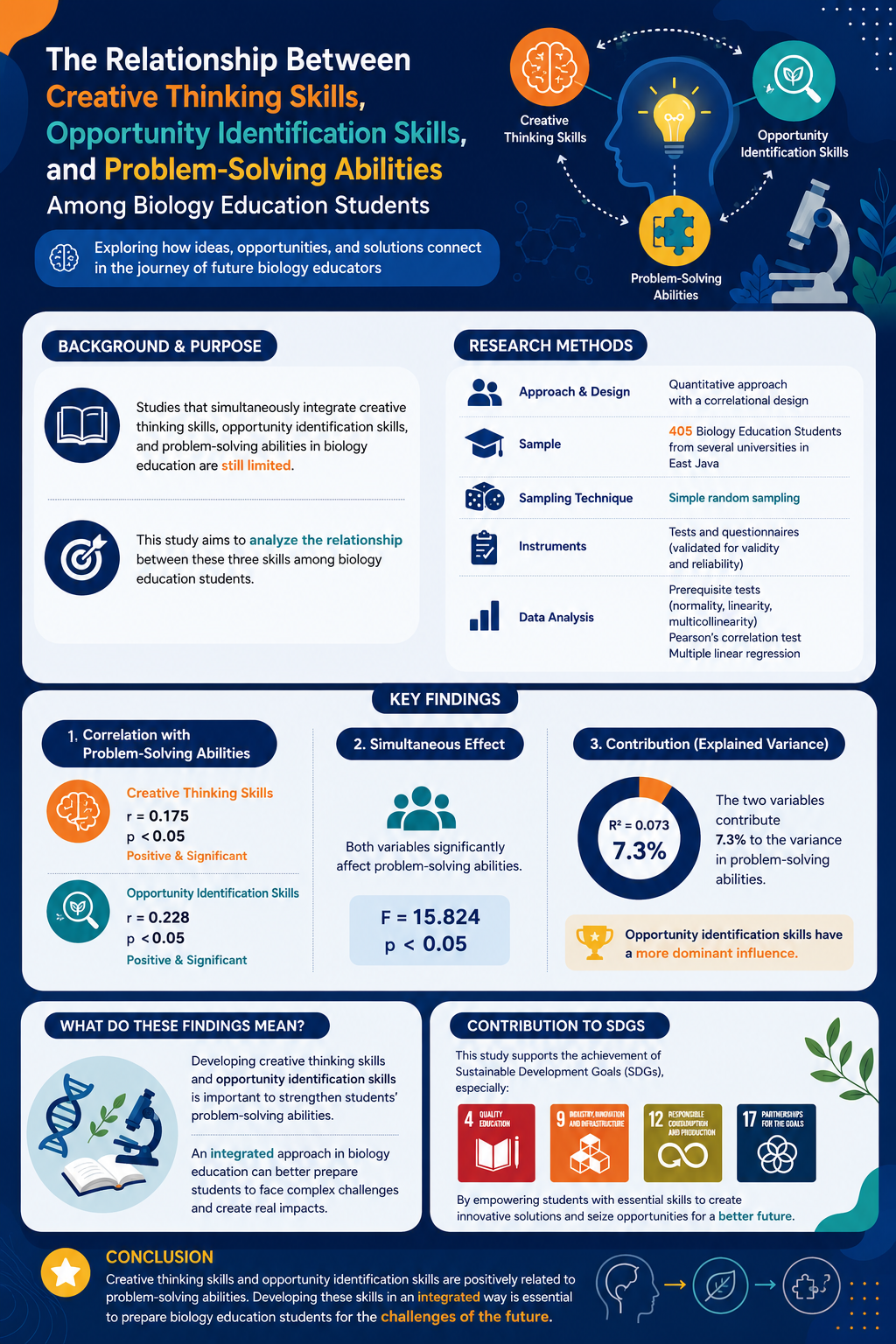
Understanding of the relationship among creative thinking, opportunity identification, and problem-solving skills among biology education students remains limited. These competencies are essential for fostering innovative, contextual, and SDG-oriented biology learning. This study aims to analyze the relationship between creative thinking skills, opportunity identification skills, and problem-solving abilities among biology education students.The study was motivated by the limited number of studies that simultaneously integrate these three skills within the context of biology education. The research employed a quantitative approach with a correlational design. The research sample consisted of 405 biology education students from several universities in East Java, selected using simple random sampling. The research instruments comprised tests and questionnaires that had been validated for validity and reliability. Data analysis utilized prerequisite tests (normality, linearity, and multicollinearity), Pearson’s correlation test and multiple linear regression. The results indicated that creative thinking skills (r = 0.175; p < 0.05) and opportunity identification skills (r = 0.228; p < 0.05) had a positive and significant relationship with problem-solving abilities. Simultaneously, both variables had a significant effect (F = 15.824; p < 0.05) with a contribution of 7.3% (R² = 0.073), whereby the ability to identify opportunities had a more dominant influence. These findings highlight the importance of developing these skills in an integrated manner within biology education to support the Sustainable Development Goals (SDGS).
Abstrak. Pemahaman mengenai hubungan antara keterampilan berpikir kreatif, identifikasi peluang, dan pemecahan masalah pada mahasiswa pendidikan biologi masih terbatas. Padahal, ketiga keterampilan tersebut merupakan kompetensi penting untuk mendukung pembelajaran biologi yang inovatif, kontekstual, dan berorientasi pada pencapaian SDGs. Penelitian ini bertujuan untuk menganalisis hubungan antara keterampilan berpikir kreatif, keterampilan mengidentifikasi peluang, dan keterampilan pemecahan masalah pada mahasiswa pendidikan biologi. Penelitian ini dilatarbelakangi oleh masih terbatasnya kajian yang mengintegrasikan ketiga keterampilan tersebut secara simultan dalam konteks pendidikan biologi. Penelitian menggunakan pendekatan kuantitatif dengan desain korelasional. Sampel penelitian berjumlah 405 mahasiswa pendidikan biologi dari beberapa perguruan tinggi di Jawa Timur yang dipilih menggunakan teknik simple random sampling. Instrumen penelitian berupa tes dan angket yang telah diuji validitas dan reliabilitasnya. Analisis data menggunakan uji prasyarat (normalitas, linearitas, dan multilkolinearitas), uji korelasi Pearson dan regresi linear berganda. Hasil penelitian menunjukkan bahwa keterampilan berpikir kreatif (r = 0,175; p < 0,05) dan keterampilan mengidentifikasi peluang (r = 0,228; p < 0,05) memiliki hubungan positif dan signifikan dengan keterampilan pemecahan masalah. Secara simultan, kedua variabel berpengaruh signifikan (F = 15,824; p < 0,05) dengan kontribusi sebesar 7,3% (R² = 0,073), di mana keterampilan mengidentifikasi peluang memiliki pengaruh yang lebih dominan. Temuan ini menunjukkan pentingnya pengembangan keterampilan tersebut secara terintegrasi dalam pembelajaran biologi untuk mendukung tujuan Pembangunan Berkelanjutan (SDGs).
References
Alberto, M. C. L., Viviana, B. V. C., Vladimir, B. E. C., & Fernanda, P. A. P. (2024). Innovative strategies to strengthen teaching-researching skills in chemistry and biology education: A systematic literature review. Fronteirs in Education, 9, 1–19. https://doi.org/10.3389/feduc.2024.1363132
Amin, A. M., Corebima, A. D., Zubaidah, S., & Mahanal, S. (2020). The correlation between metacognitive skills and critical thinking skills at the implementation of four different learning strategies in animal physiology lectures. European Journal of Educational Research, 9(1), 143–163. https://doi.org/10.12973/eu-jer.9.1.143
Anwar, Y., Widodo, A., Alfatih, Z., Kartika, D., Ariska, M., & Yusliani, N. (2025). Technological pedagogical content knowledge in biology education: Assessing teachers’ readiness. Jurnal Pendidikan IPA, 14(3), 430–442. https://doi.org/10.15294/jpii.v14i3.22908
Bandura, A. (1997). Self-efficacy: The exercise of control. W.H. Freeman and Company.
Chang, T. S., Wang, H. C., Haynes, A. M. D., Song, M. M., Lai, S. Y., & Hsieh, S. H. (2022). Enhancing student creativity through an interdisciplinary, project-oriented problem-based learning undergraduate curriculum. Thinking Skills and Creativity, 46, 101173. https://doi.org/10.1016/J.TSC.2022.101173
Dilekçi, A., & Karatay, H. (2023). The effects of the 21st century skills curriculum on the development of students’ creative thinking skills. Thinking Skills and Creativity, 47, 101229. https://doi.org/10.1016/J.TSC.2022.101229
Dwyer, C. P., Campbell, D., & Seery, N. (2025). An evaluation of the relationship between critical thinking and creative thinking: Complementary metacognitive processes or strange bedfellows? Journal of Intelligence, 13(2), 23. https://doi.org/10.3390/jintelligence13020023
Faizah, U., Susantini, E., Sri Prastiwi, M., Raharjo, R., Indana, S., Kuswanti, N., & Ali, M. (2024). Profile of potential prospective biology teachers designing SDGs-Based Teaching Modules on learning planning courses to realize quality education. In E3S Web of Conferences (Vol. 568, p. 04025). EDP Sciences. https://doi.org/https://doi.org/10.1051/e3sconf/202456804025
Gedeon, S. A., & Valliere, D. (2018). Closing the loop: Measuring entrepreneurial self-efficacy to assess student learning outcomes. Entrepreneurship Education and Pedagogy, 1(4), 272–303. https://doi.org/10.1177/2515127418795308
Greenstein, L. (2012). Assessing 21st century skills: A guide to evaluating mastery and authentic learning. In Assessing 21st century skills: A guide to evaluating mastery and authentic learning. Corwin Press Sage Compnay.
Hu, Y., Wang, M., Ren, L., & Chen, Y. (2025). Innovation and assessment system for the development of biology teaching content aligned with sustainable development goals. Frontiers in Interdisciplinary Educational Methodology, 2(1), 1–16. https://doi.org/10.71465/w7gq9391
Jeronen, E., & Jeronen, J. (2026). Bibliometric and content analysis of sustainable education in biology for promoting sustainability at primary and secondary schools and in teacher education. Education Sciences, 16(2), 201. https://doi.org/10.3390/educsci16020201
Jiatong, W., Murad, M., Bajun, F., Tufail, M. S., Mirza, F., & Rafiq, M. (2021). Impact of entrepreneurial education, mindset, and creativity on entrepreneurial intention: mediating role of entrepreneurial self-efficacy. Frontiers in psychology, 12, 724440. https://doi.org/10.3389/fpsyg.2021.724440
Jonassen, D. H. (2011). Learning to solve problems: A handbook for designing problem-solving learning environments. Routledge. https://doi.org/10.4324/9780203847527
Leest, B., & Wolbers, M. H. J. (2021). Critical thinking , creativity and study results as predictors of selection for and successful completion of excellence programmes in Dutch higher education institutions programmes in Dutch higher education institutions. European Journal of Higher Education, 11(1), 29–43. https://doi.org/10.1080/21568235.2020.1850310
McGee, J. E., & Peterson, M. (2019). The long-term impact of entrepreneurial self-efficacy and entrepreneurial orientation on venture performance. Journal of Small Business Management, 57(3), 720–737. https://doi.org/10.1111/jsbm.12324
Mróz, A., & Ocetkiewicz, I. (2021). Creativity for sustainability: How do polish teachers develop students’ creativity competence? Analysis of research results. In Sustainability (Vol. 13, Issue 2, p. 571). https://doi.org/10.3390/su13020571
Nazzal, L. J., & Kaufman, J. C. (2020). The relationship of the quality of creative menemukan solusi permasalahan stages to overall creativity in engineering students. Thinking Skills and Creativity, 38, 100734. https://doi.org/10.1016/J.TSC.2020.100734
Nguyen, K., Ben Khallouq, B., Schuster, A., Beevers, C., Dil, N., Kay, D., Kibble, J. D., & Harris, D. M. (2017). Developing a tool for observing group critical thinking skills in first-year medical students: a pilot study using physiology-based, high-fidelity patient simulations. Advances in Physiology Education, 41(4), 604–611. https://doi.org/10.1152/advan.00126.2017
Nurwidodo, N., Ibrohim, I., Sueb, S., & Muchlas, F. (2023). Improving the creative thinking and collaborative skills of prospective biology teachers using the EMKONTAN learning model in environmental science courses. Jurnal Pendidikan Biologi Indonesia, 9(1), 15–25. https://doi.org/10.22219/jpbi.v9i1.24382
Pamungkas, R., Suwono, H., Ibrohim, I., & Subiantoro, A. W. (2025). Empowering future biology teachers: Integrating STEM and design thinking for effective sustainability learning. SEAQIS Journal of Science Education, 5(02), 34-46. https://doi.org/10.58249/sjse.v5i02.175
Pinareswati, A. D., Rahayu, Y. S., & Yuliani, Y. (2025). Analysis of students’ creative thinking skills in ecology: Digital mind maps supporting sustainable development goals. Edubiotik : Jurnal Pendidikan, Biologi Dan Terapan, 10(01 SE-Articles), 198–213. https://doi.org/10.33503/ebio.v10i01.1176
Purwanti, Hayat, M. S., & Dewi, E. R. S. (2024). Students ’ creative thinking skills with STEAM-SDGs approach to energy concept : Rasch model analysis. Jurnal Penelitian Pendidikan IPA, 10(12), 11152–11161. https://doi.org/10.29303/jppipa.v10i12.9532
Rahmawati, I., & Turista, D. D. R. (2026). Trends in biology learning innovations for strengthening 21st century skills toward achieving the sustainable development goals (SDGs). Jurnal Penelitian Pendidikan IPA, 12(1), 29–40. https://doi.org/10.29303/jppipa.v12i1.14485
Rauth, I., Köppen, E., Jobst, B., & Meinel, C. (2010). Design thinking: An educational model towards creative confidence. Proceedings of the 1st International Conference on Design Creativity ICDC 2010, 1–8. Retrieved from https://research.chalmers.se/en/publication/173074
Reviola, D., Hastuti, P. W., Tyas, R. A., Anjarsari, P., & Roektiningroem, E. (2026). The influence of the problem-based learning model integrated with SDGs-7 on critical thinking and collaboration skills. Jurnal Penelitian Pendidikan IPA, 12(3 SE-Research Articles), 257–265. https://doi.org/10.29303/jppipa.v12i3.12884
Saoula, O., Shamim, A., Ahmad, M. J., & Abid, M. F. (2023). Do entrepreneurial self-efficacy, entrepreneurial motivation, and family support enhance entrepreneurial intention? The mediating role of entrepreneurial education. Asia Pacific Journal of Innovation and Entrepreneurship, 17(1), 20–45. https://doi.org/10.1108/apjie-06-2022-0055
Saseendran, A., & Thomas, M. V. (2025). Integration of design thinking and educational technology into science education: A conceptual framework for the development of sustainability competencies. Journal of Educational Technology Development and Exchange, 18(4), 91–116. https://doi.org/https://doi.org/10.18785/jetde.1804.05
Taufik, L. M., Widodo, A., Surtikanti, H. K., & Rahman, T. (2026). Development of a systems-thinking-based assessment instrument for environmental literacy and Problem-solving abilities in SDG 6 contexts. Journal of Environment and Sustainability Education, 4(1 SE-Articles), 1–11. https://doi.org/10.62672/joease.v4i1.173
Todorova, A., Kostadinova, I., & Stefanova, S. (2025). Developing sustainability problem-solving abilities through internet of things projects. In Sustainability (Vol. 17, Issue 22, p. 10367). https://doi.org/10.3390/su172210367
Urban, B. (2020). Entrepreneurial alertness, self-efficacy and social entrepreneurship intentions. Journal of Small Business and Enterprise Development, 27(3), 489–507. https://doi.org/10.1108/JSBED-08-2019-0285
Widiana, L. V. W., Prayitno, B. A., & Sugiharto, B. (2024). Framework menemukan solusi permasalahan based augmented reality media to empower scientific explanation skill. JPBI (Jurnal Pendidikan Biologi Indonesia), 10(2), 631–639. https://doi.org/10.22219/jpbi.v10i2.32387
Yalçın, V., & Erden, Ş. (2021). The effect of STEM activities prepared according to the design thinking model on preschool children's creativity and problem-solving skills. Thinking Skills and Creativity, 41, 100864. https://doi.org/10.1016/j.tsc.2021.100864
Downloads
Published
Issue
Section
License
Copyright (c) 2025 Ika Wardani, M. Arsyad

This work is licensed under a Creative Commons Attribution-NonCommercial-ShareAlike 4.0 International License.

This work is licensed under a Creative Commons Attribution-NonCommercial-ShareAlike 4.0 International License.