Validity of Rubiaceae ethnobotany popular science book for developing students' critical thinking skills
DOI:
https://doi.org/10.58362/hafecspost.v5i1.170Keywords:
popular science books, validation, EDR, critical thinking, ethnobotanyAbstract
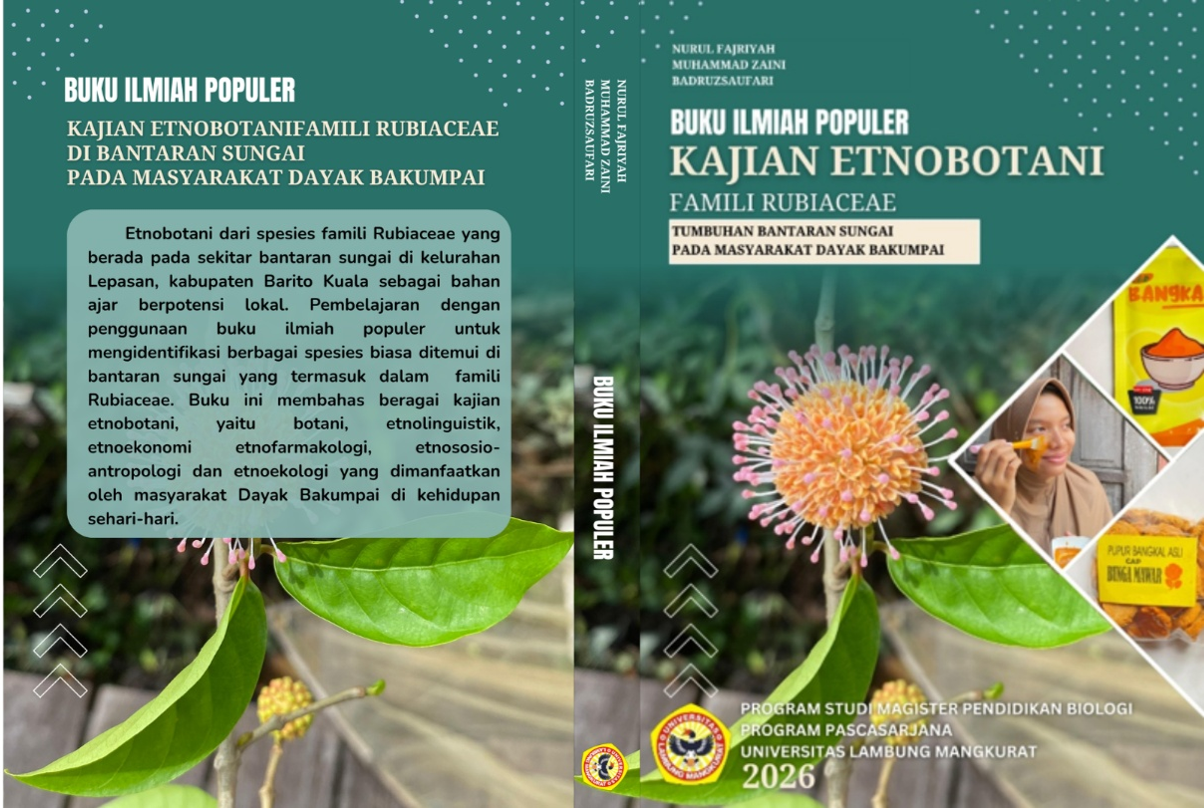
The use of teaching materials based on local potential among university students remains limited; therefore, a popular science book has been developed to enhance students’ critical thinking skills, thereby assisting them in higher education or the workforce. This study aims to describe the validity and practicality of the content of the Popular Science Book (PSB) on the ethnobotany of the Rubiaceae family among the Dayak Bakumpai community for training students’ critical thinking skills. This study employed Education Design Research (EDR) using Tessmer’s formative evaluation, limited to expert validation and one-to-one testing. The research data consisted of validator questionnaire forms and content appeal (practicality) questionnaire forms. The results of this study yielded a validity score of 91.03 (highly valid) and a content practicality score of 92.95 (very good). Based on these results, it is concluded that the BIP is suitable and practical for use as teaching material based on local potential that is relevant to students’ needs in developing critical thinking skills.
Abstrak. Penggunaan bahan ajar pada mahasiswa berbasis potensi lokal masih belum banyak sehingga dikembangkan buku illmiah popular yang dapat meningkatkan keterampilan berpikir kritis mahasiswa untuk membantu mahasiswa dalam Tingkat Pendidikan lanjutan ataupun dunia kerja. Penelitian ini bertujuan mendeskripsikan validitas dan kepraktisan isi Buku Ilmiah Populer (BIP) etnobotani famili Rubiaceae masyarakat Dayak Bakumpai untuk melatih keterampilan berpikir kritis mahasiswa. Jenis penelitian ini menggunakan Education Design Research (EDR) dengan evaluasi formatif Tessmer yang dibatasi hingga uji validasi ahli dan uji perorangan (one-to-one). Data penelitian ini berupa lembar angket validator dan lembar angket daya Tarik (kepraktisan isi). Hasil penelitian ini memperoleh hasil validitas sebesar 91,03 (sangat valid) dan hasil kepraktisan isi sebesar 92,95 (sangat baik). Berdasarkan hasil penelitian ini disimpulkan bahwa BIP layak dan praktis untuk digunakan sebagai bahan ajar berbasis potensi lokal yang relevan dengan kebutuhan mahasiswa dalam melatih keterampilan berpikir kritis.
References
Abrami, P. C., Bernard, R. M., Borokhovski, E., Waddington, D. I., Wade, A. A., & Persson, T. (2015). Strategies for teaching students to think critically: A meta-analysis. Review of Educational Research, 85(2), 275–314. https://doi.org/10.3102/0034654314551063
Akbar, S. (2013). Instrumen perangkat pembelajaran. Remaja Rosdakarya.
Dharmono, D., Mahrudin, M., & Riefani, M. K. (2019). Kepraktisan handout struktur populasi tumbuhan rawa dalam meningkatkan keterampilan berpikir kritis mahasiswa pendidikan biologi. BIO-INOVED: Jurnal Biologi-Inovasi Pendidikan, 1(2), 99-104. https://dx.doi.org/10.20527/binov.v1i2.7864
Facione, P. A. (2013). Critical thinking: What it is and why it counts. Insight Assessment. https://www.law.uh.edu/blakely/advocacy-survey/Critical%20Thinking%20Skills.pdf
Fahmi, F., Fajeriadi, H., & Irhasyuarna, Y. (2021). Feasibility of the prototype of teaching materials on the topic of classification of living things based on the advantage of local wetland. BIO-INOVED: Jurnal Biologi-Inovasi Pendidikan, 3(2), 113-118. https://dx.doi.org/10.20527/bino.v3i2.10322
Fajeriadi, H., Zaini, M., Dharmono, D., Nugroho, B. A., Fahmi, F., & Fitriani, A. (2024). The popular scientific book-based coastal gastropod’s diversity as local potential: Practicality and effectiveness on student’s critical thinking ability. JPBI (Jurnal Pendidikan Biologi Indonesia), 10(2), 580-590. https://doi.org/10.22219/jpbi.v10i2.32255
Firmansyah, R., Habib, I. M. A., & Prihandini, D. R. (2023). Application of popular scientific books to improve students’ scientific literacy. International Social Sciences and Humanities, 2(2). https://doi.org/10.32528/issh.v2i2.262
Halwa, A. (2024). Pengembangan buku ilmiah populer etnobotani tumbuhan tradisi mandi tujuh bulan pada masyarakat Dayak Bakumpai Kelurahan Lepasan untuk melatihkan kemampuan berpikir kritis (Unpublished master's thesis). Universitas Lambung Mangkurat.
Husna, D. K., Mahrudin, M., & Utami, N. H. (2025). Validitas buku ilmiah populer keragaman jenis vegetasi pohon di tepian sungai kawasan Bendung Amandit Desa Malutu pada mata kuliah ekologi lahan basah. ORYZA: Jurnal Pendidikan Biologi, 14(2). https://doi.org/10.33627/oz.v14i2.3537
Irianti, R., Dharmono, & Mahrudin, M. (2021). Analisis kepraktisan buku ilmiah populer keanekaragaman jenis ikan berbasis penelitian sebagai bahan pengayaan mata kuliah zoologi vertebrata konsep ikan. Wahana-Bio: Jurnal Biologi dan Pembelajarannya, 13(1), 52–63. https://ppjp.ulm.ac.id/journal/index.php/wb/article/download/9599/7318
Khalidi, M., Zaini, M., & Kaspul, K. (2024). Pengembangan lembar kerja peserta didik elektronik kelas reptilia untuk keterampilan berpikir kritis siswa dan keterampilan kinerja siswa SMA. Jurnal Inovasi Pembelajaran Biologi, 5(1), 12–21. https://doi.org/10.26740/jipb.v5n1.p12-21
Mardhatillah, R. (2024). Pengembangan buku ilmiah populer etno-farmakologi pada masyarakat Dayak Bakumpai untuk melatih keterampilan berpikir kritis mahasiswa (Unpublished master's thesis). Universitas Lambung Mangkurat.
Mumpuni, K. E., Susilo, H., & Fathur, R. (2013). Potensi tumbuhan lokal sebagai sumber belajar biologi. In Prosiding Seminar Nasional XI Pendidikan Biologi FKIP UNS (pp. 823–829). https://jurnal.uns.ac.id/prosbi/article/download/7922/7086
OECD. (2022). PISA 2022 results (Volume I): The state of learning and equity in education. OECD Publishing. https://www.oecd.org/en/publications/pisa-2022-results-volume-i_53f23881-en.html
OECD. (2024). Education at a glance 2024: OECD indicators. OECD Publishing. https://www.oecd.org/en/publications/education-at-a-glance-2024_c00cad36-en.html
Okolie, O. T., Igwenagu, P. C., & Uzordinma, C. E. (2021). Enhancing students’ critical thinking skills through engagement with innovative pedagogical practices in the Global South. Higher Education Research & Development, 41(4), 1–15. https://doi.org/10.1080/07294360.2021.1896482
Putri, A. I., Dharmono, D., & Zaini, M. (2020). Validitas buku ilmiah populer keanekaragaman spesies family Fabaceae dalam meningkatkan keterampilan proses sains mahasiswa. Quantum: Jurnal Inovasi Pendidikan Sains, 11(2), 186–195. https://doi.org/10.20527/quantum.v11i2.8822
Ramadhan, F., Soendjoto, M. A., & Dharmono, D. (2020). Practicality pocketbook “Keanekaragaman Lepidoptera di hutan mangrof”. BIO-INOVED: Jurnal Biologi-Inovasi Pendidikan, 2(2), 71-75. https://dx.doi.org/10.20527/bino.v2i2.8551
Syahfitri, J., & Muntahanah, M. (2024). The effectiveness of local wisdom-based interactive digital module on students’ critical thinking disposition. International Journal of Evaluation and Research in Education, 13(4), 2171–2178. https://doi.org/10.11591/ijere.v13i4.28256
Tessmer, M. (1993). Planning and conducting formative evaluations. Cogan Page.
Downloads
Published
Issue
Section
License
Copyright (c) 2025 Nurul Fajriyah, Muhammad Zaini, Badruzsaufari Badruzsaufari

This work is licensed under a Creative Commons Attribution-NonCommercial-ShareAlike 4.0 International License.

This work is licensed under a Creative Commons Attribution-NonCommercial-ShareAlike 4.0 International License.